

To the extent that historical press releases reference BMW Manufacturing Co., LLC as the manufacturer of certain X model vehicles, the referenced vehicles are manufactured in South Carolina with a combination of U.S. origin and imported parts and components.
PressClub USA · Article.
BMW NA 50th Anniversary | 50 Stories for 50 Years Chapter 30: “The little car that could: MINI conquers the States”
Mon Jul 28 21:00:00 CEST 2025 Press Release
Small cars have always been a tough sell in the United States, where they’re typically seen as bare-bones transportation for those on a limited budget rather than as a space-saving, fuel-efficient choice for those who simply prefer a smaller, lighter vehicle. In 2002, the BMW Group upended that notion with the MINI Cooper, a car that was not only small and efficient but fun to drive, premium, and—above all—quirky. The MINI Cooper became a surprise hit in this market, and those who bought it became not just customers but a community.
Press Contact.
Thomas Plucinsky
BMW Group
Tel: +1-201-307-3701
send an e-mail
Author.
Thomas Plucinsky
BMW Group
Related Links.
Small cars have always been a tough sell in the United States, where they’re typically seen as bare-bones transportation for those on a limited budget rather than as a space-saving, fuel-efficient choice for those who simply prefer a smaller, lighter vehicle. In 2002, the BMW Group upended that notion with the MINI Cooper, a car that was not only small and efficient but fun to drive, premium, and—above all—quirky. The MINI Cooper became a surprise hit in this market, and those who bought it became not just customers but a community.

Neither of those results could have been predicted when BMW
acquired MINI in 1994, as part of its purchase of UK consortium, the
Rover Group. Mini—originally in lower case—was one of a slew of
British brands included in the deal along with Land Rover, Triumph,
MG, Riley, and Wolseley. The sale also included outdated industrial
plants, substandard product quality, and labor unrest—problems so
intractable that BMW would sell off most of the Rover Group’s assets
just six years later.
Though Mini was plagued by some of the
same problems faced by the Rover Group overall, it was retained as an
essential component of the multi-brand strategy in which the core BMW
brand was bracketed by Mini and Rolls-Royce, purchased separately.
Rolls would allow BMW to target customers for whom even a 7 or 8
Series wasn’t exclusive enough, while Mini would allow the company to
build small cars with the front-wheel drive that was anathema to BMW
in that era.
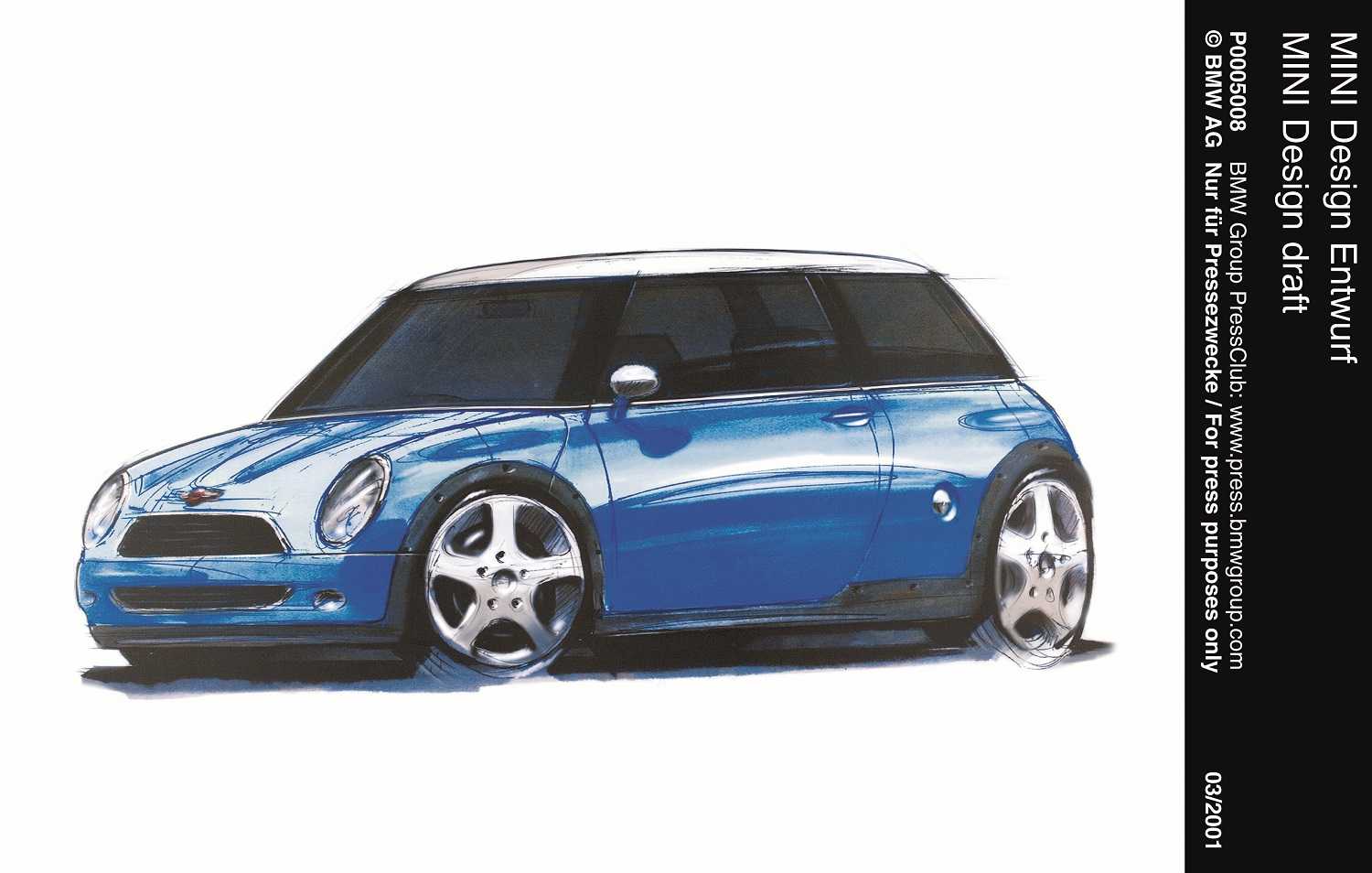
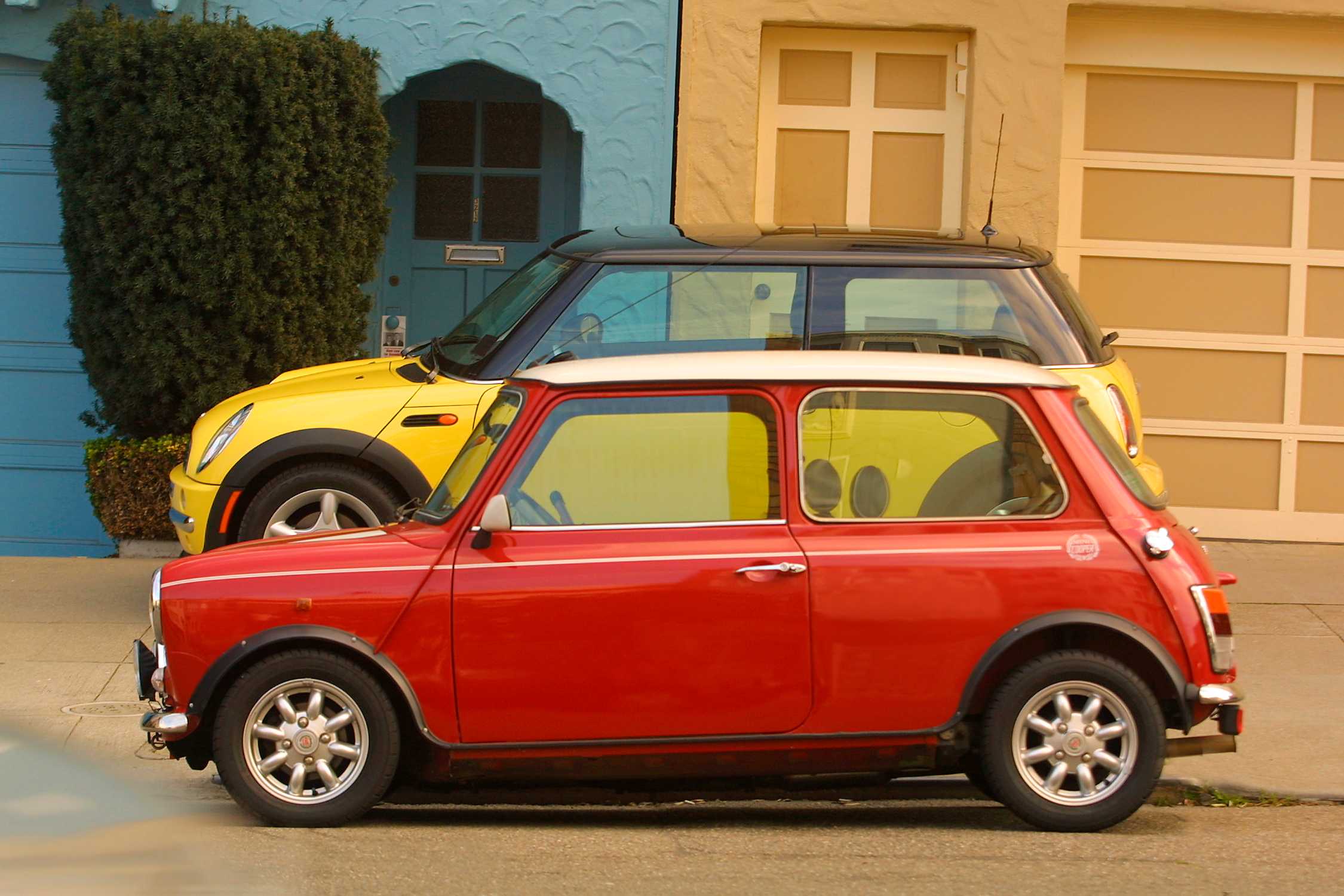
To distinguish the modern MINI from its antecedent, BMW rendered the name in all-caps. BMW then built what amounted to an all-new plant inside the existing exterior walls of the circa 1912 Morris Motors plant in Cowley, near Oxford, England. Equally important, BMW designed an all-new MINI to replace the classic Mini, which had been introduced in 1959 and updated only incrementally in the decades that followed.
The classic Mini was a ’60s style icon, endowed by Sir Alec
Issigonis—coincidentally, the great-uncle of BMW’s then-chairman Bernd
Pischetsrieder—with a cheerful demeanor that made it a favorite of
musicians, actors, and anyone else aspiring to hip style in Swinging
London. The car was a sporting legend, too, having won the Monte Carlo
Rally in 1964, ’65, and ’67. (It should have won in 1966, as well, but
was disqualified for the color of its headlamps.)
That victory
inspired Adrian van Hooydonk—then a young designer at BMW
Designworks/USA—to sketch a car he dubbed the Anniversary Concept
Vehicle (ACV) 30 in 1997. The sketch impressed BMW design chief Chris
Bangle, who approved the creation of a running prototype. With
distinctive fender creases and stunning red paint with white stripes,
the ACV30 was described by Bimmer magazine’s Jay Jones as
“pure adrenaline in a small package.”
Van Hooydonk’s concept
didn’t make it into production, and neither did an economy-focused
concept from the Rover Group. Instead, BMW opted for a design by Frank
Stephenson based on a theoretical evolution of the Mini over three
decades.
Under the skin, the MINI got modern mechanicals
designed via a rather complicated collaboration between Rover
engineers and those at BMW. The car got BMW’s signature MacPherson
strut front and multilink rear axles, along with state-of-the-art
electronics—including Cornering Brake Control, Dynamic Stability
Control, and Electronic Brake Distribution—shared with the latest
BMWs. For motive power, the MINI Cooper used a transverse-mounted
four-cylinder engine built in Brazil, at a plant owned jointly by BMW
and Chrysler.
The new MINI made its first huge splash in Paris,
and it didn’t disappoint those who drove it at the international press
launch. Writing for Bimmer magazine’s October 2001 issue, Ian
Kuah said the new MINI “redefines handling and ride in small cars,
bringing unprecedented mechanical refinement to the supermini class.
It’s also chic, well-built, good value for money, and downright desirable.”
At the time, the MINI hadn’t been announced for the U.S. Behind the
scenes, however, a small group of employees at BMW of North America
had spent the previous six years setting the stage for its arrival.

When the MINI was first mooted, BMW of North America was led by
President Victor Doolan, a native of Great Britain. Doolan had always
liked the original Mini, and he knew that U.S. sales volumes would be
crucial to the MINI’s success worldwide. “The problem was the cost of
the vehicle, which made it too expensive to be a viable project in the
U.S.,” Doolan said.
To overcome that obstacle, BMW NA optimized
the wholesale-retail relationship, allowing MINI dealers to share
back-end services and administration with their BMW franchises while
selling MINI from dedicated showrooms. To further enhance
profitability, the BMW NA’s product planners—namely Rich Brekus and
Bert Holland—pursued a premium strategy in which the base MINI offered
in the U.S. would not be the 89-horsepower MINI One but the
113-horsepower MINI Cooper. Above that, the 168-horsepower MINI Cooper
S and 197-horsepower MINI John Cooper Works would complete the lineup.
That strategy was approved by BMW NA’s then-CEO Helmut Panke, but it came into doubt in February 1996, when Panke left Woodcliff Lake for Munich and a seat on the BMW AG Board of Management. Panke’s replacement as BMW NA CEO, Dr. Heinrich Heitmann, insisted that MINI would never work in the U.S.
Nonetheless, Heitmann supported the investigations then underway, while other key players within BMW of North America remained committed to MINI. That group included Stefan Krause, then CEO of BMW Financial Services. Krause assigned Rich Steinberg—one of the prime architects of BMW NA’s captive leasing program and a longtime enthusiast of British cars—to research the financial aspects of bringing MINI to the US.
As the policy differences between Panke and Heitmann
demonstrated, changes in company leadership can lead to abrupt shifts
in strategy, particularly when they occur on the board level in
Munich. That’s exactly what happened in February 1999, when fallout
from the disastrous Rover acquisition saw Pischetsrieder ousted from
the chairmanship. When the supervisory board chose to name Joachim
Milberg chairman rather than R&D chief Dr. Wolfgang Reitzle—the
second time Reitzle had been passed over for the chairmanship—Reitzle
left BMW for Ford. Two months later, BMW NA experienced a similar
upheaval: Doolan resigned as President to join Reitzle at Ford, while
CEO Heitmann left Woodcliff Lake for Munich and a seat on the BMW
board.
On May 1, 1999, Tom Purves arrived at BMW NA as a
replacement for both Doolan and Heitmann, taking the newly
consolidated position of Chairman and CEO of BMW (US) Holding Corp. A
native of Scotland, Purves had been in charge of sales at Rover while
the new MINI was under development, and he was eager to bring MINI to
the U.S.
In December 1999, MINI USA became a corporate division
of BMW NA, with Steinberg tapped as its first employee. Alongside
Steinberg, Andrew Cutler would handle communications for the new
brand. “In both the pre- and post-launch stages, we relied heavily on
PR, with media activations that helped get buzz around the brand even
though we didn’t have a big marketing budget,” Cutler said.

MINI now had official status within BMW NA, but bringing a
premium hatchback to the U.S. remained a risky proposition. Full-size
SUVs were ascendant, and the unmet sales expectations for the 318ti
hatchback were still fresh in BMW NA’s institutional memory.
Even so, BMW NA needed MINI to succeed: The car would return
better fuel economy with lower emissions than the larger BMW-badged
models, reducing BMW NA’s Corporate Average Fleet Economy (CAFE)
rating and helping the company avoid fines like the record $28 million
it paid in 2001.
“On a worldwide basis, we have to be involved
with building more cars with smaller engines in order to comply with
legislation,” Purves said. “We also know that we have to keep in touch
with younger customers, who one day will be 7 Series customers. The
MINI does all of those things for us.”
Since those younger
customers tended to live in cities, Steinberg’s team focused on urban
areas when soliciting some 70 MINI dealers from BMW’s 350 or so
dealerships nationwide. “Our colleagues from overseas put together a
traveling roadshow, which included two classic Minis and a PowerPoint
presentation,” Steinberg said. “We went to all four regions and told
the BMW dealers what the franchise was about, what the car would look
like, the kind of investment we were looking for, with a stand-alone
selling environment and corporate ID. We invited proposals, which we
evaluated to make sure that the MINI brand values would be properly represented.”

As MINI USA was putting together its dealer network, the division got
a new leader when Purves appointed Jack Pitney to the position in
January 2001. Pitney was certain the MINI could succeed in this
market, and he’d developed his own launch plan for the brand while
serving as BMW NA’s Head of Corporate Communications.
“Jack had
been a PR guy, and he was really good at it,” Steinberg said. “He
managed media communications better than I could, and he also managed
dealer relations and internal relations, which were definitely needed.
He was the right guy at the right time.”
Shortly thereafter,
MINI USA completed the long search for an ad agency, naming the
Miami-based firm Crispin Porter & Bogusky its agency of record on
February 13, 2001.
“Crispin had been unknown to me, and unknown
to most of America, for that matter,” Steinberg said. “Crispin
completely blew our doors off. They pitched us with the ‘Let’s Motor’
tagline, and The Book of Motoring, which basically explained
what the brand represented. It was so easy for us to move forward with
them, even though they’d never had a car account before.”
CP&B had plenty of work to do prior to the car’s on-sale
date in March 2002. BMW NA’s preliminary market research had shown
that only two percent of potential U.S. customers had even heard of
the old Mini, much less BMW’s new MINI.
On a modest $25 million
budget, CP&B worked with Kerri Martin, MINI USA’s Senior Director
of Marketing, to introduce MINI to the American public. CP&B’s ad
campaign avoided television in favor of print, emphasizing removable
“tear-away” magazine inserts that could be shared among potential
customers. The agency placed billboards in urban areas, with slogans
like “The SUV Backlash Starts Now” reinforced by a MINI mounted on the
roof of an SUV and driven on city streets to emphasize the vehicles’
contrasting dimensions.
CP&B’s print ads—placed in
general-interest magazines like The New Yorker, Rolling
Stone, and The Atlantic more frequently than in
automotive magazines—emphasized an entirely different set of virtues
than BMW’s usual power and performance. “LET’S SIP, NOT GUZZLE,” read
one ad. “Let’s leave the off-road vehicles off road. Let’s stop
pretending we live in the jungle. Let’s stop intimidating each other.
Let’s not use the size of our vehicle to compensate for other
shortcomings. Let’s reclaim our garage space. Let’s be nimble. Let’s
be quick. Let’s be honest. LET’S MOTOR.™”
The campaign was
wildly successful. “By the time the MINI made its debut in March 2002,
more than 50,000 people had logged onto its website, miniusa.com,
to express interest in buying one. By the end of the year, brand
recognition in the United States had risen to 53 percent,” reported
The New York Times. “Sales of the MINI reached 30,000 in
the first year, about 10,000 more than the company had anticipated,
defying conventional wisdom that consumers would not pay a premium
price for a tiny car.”
MINI’s actual sales total was 24,590 in
2002, followed by 36,010 in 2003, MINI’s first full year on the U.S.
market. Both figures could have been higher: With the Oxford plant
still ramping up, many customers had to wait months for their cars to
be delivered. (The vast majority were—and remain—ordered to the
individual customer’s taste where color, upholstery, wheels, and other
accessories were concerned.) Rather than bemoan the delays, MINI
created a sense of excitement around them.
“We started a campaign
called ‘Make Waiting Fun,’ in which customers who ordered a MINI could
track its journey from the production line, to the boat, to the port,
and to the dealership,” Steinberg said. “A lot of companies do it now,
but we pioneered it.”

Once they got their cars, MINI owners joined an enthusiastic
community of like-minded individuals, one that recalled that of BMW
2002 owners in the late 1960s. This, too, was part of the
award-winning marketing plan created by CP&B and Martin.
“The Book of Motoring had rules like, ‘MINI customers need
to wave to other MINI drivers.’ It created this community that we’re
so fortunate to have, in which MINI is not just transportation but
part of their lives,” said Patrick McKenna, who became MINI’s Head of
Product Planning and Consumer Events in 2008.
CP&B’s ads
encouraged MINI owners to explore the country’s vast open spaces.
“LET’S SEND GREETINGS FROM MILE MARKER 73. Let’s lose radio reception.
Let’s make it on fumes. Let’s hold it until the rest stop. Let’s beat
our postcards home. LET’S MOTOR.™”
MINI owners took that message
to heart: In 2006, some 4,000 MINI drivers joined the first-ever MINI
Takes the States, a 17-day cross-country journey from New York to San
Francisco. The event evolved out of a challenge faced by Jim McDowell
shortly after he took over as head of MINI USA in 2005, following a
job swap in which Pitney became Vice-President of Marketing for BMW NA.

“Munich had committed us to sell 200 identical MINI John Cooper Works
GPs,” McDowell said. “What is a brand based on individualization going
to do with 200 identical cars, and at a higher price? Maybe we could
get each dealer to take one car. Okay, that’s 70. What will we do with
the other 130? We could have an American Tourist delivery program,
maybe at Laguna Seca. But what about people on the East Coast? Maybe
we could do the same thing at Lime Rock. That’s where MINI Takes the
States came from.”
As McDowell and Pitney were swapping jobs,
Crispin Porter & Bogusky resigned the MINI account to pursue
Volkswagen. For McDowell, CP&B’s departure presented an
opportunity. “We wanted to be able to move into new directions,”
McDowell said. “We weren’t going to be able to advertise on billboards
forever.”
After a brief search, the contract was awarded to
Sausalito, California agency Butler, Shine, Stern and Partners. The
firm redesigned MINI’s brand image and expanded MINI’s experiential
marketing with “Motortober” events in dealerships over Halloween. For
the third Motortober, rock band KISS helped raise money for disaster
relief through the sale of co-branded MINI-KISS merchandise.
In
2009, BMW chose MINI for its first foray into electric mobility. The
car’s size was similar to that of the forthcoming i3 city car, and
MINI drivers were eager to help BMW develop a battery-electric
powertrain. “The MINI e was exhilarating in terms of performance,”
McDowell said, “but it was absolutely miserable on cold days. If you
used the heat, you had a very short range. You had to pick between
heating and getting home!”

McDowell retired at the end of 2013, the year MINI sales hit a
record 66,502 cars. He was succeeded in turn by David Duncan (who’d
set up the original MINI dealer network with Steinberg), Thomas
Felbmair, and now Michael Peyton, who’s run the division since 2019.
Over the ensuing decade, MINI sales have ebbed and flowed with gas
prices and customer preferences.
The model lineup has expanded
and contracted over the ensuing years, as have the dimensions of each
MINI. The portfolio has been rebalanced under Peyton’s direction, with
11 models variants in four body configurations – a two-door,
four-door, convertible, and compact SUV—available with
internal-combustion or battery-electric powertrains.
MINI USA remains a small but enthusiastic team within BMW NA, giving each member opportunities for creativity and flexibility. “We had six people running an entire marketing department for the whole U.S.,” said Tom Salkowsky, who joined MINI as Head of Marketing Communications in 2010. “Everybody’s doing two or three jobs, and we’re going to get it done. I think back to an infamous Jack Pitney quote, ‘There’s nothing we can’t solve with a few beers and a couple of pizzas in the conference room.’ That exuberance permeated the company.”
It still does. More than 20 years after its introduction to the U.S., MINI remains “a small, fun-to-drive car with a big heart” as Peyton describes it. MINI USA continues to host customer-focused events like MINI Takes the States, and to collaborate with hip, design-based organizations like Pantone, for which it wrapped a MINI Cooper Convertible in 2025’s Color of the Year, Mocha Mousse.

Most importantly, MINI continues to inspire enthusiasts to
motor: taking road trips, enjoying the scenery, and coming together as
a community of like-minded individuals.